
Last updated 23 November 2026. Checked against the ATO’s pages on the difference between employees and contractors, common myths and TPAR reporting, plus the Fair Work Ombudsman’s independent contractor changes.
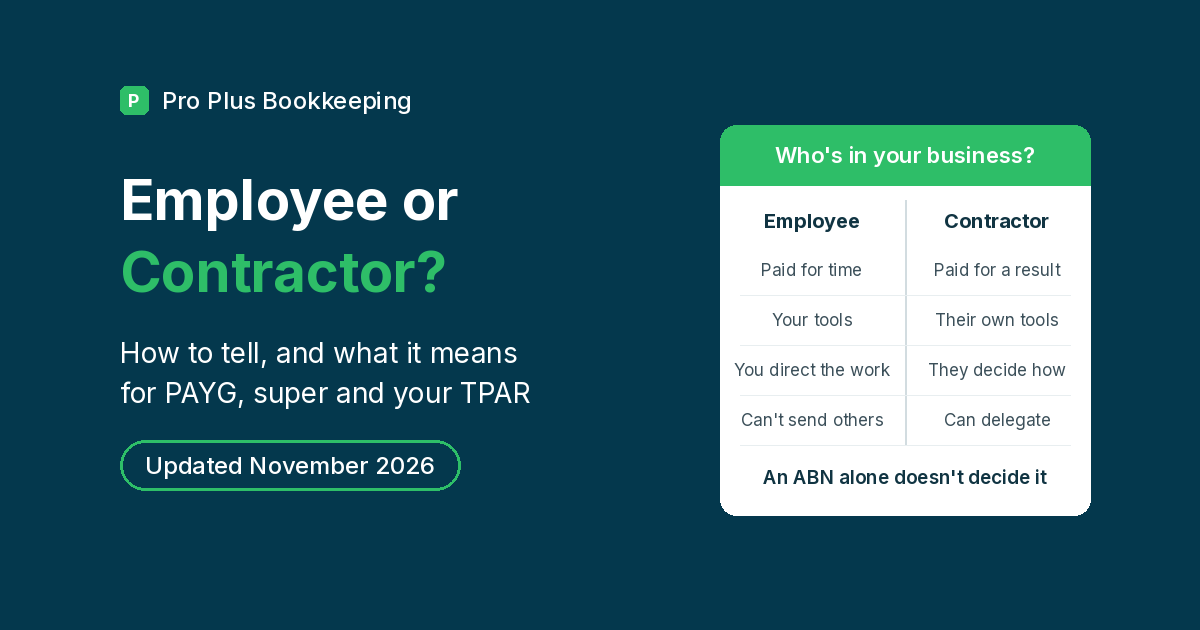
Short answer: an employee works in your business, as part of it. A contractor provides services to your business while running their own. An ABN, an invoice or a contract that says “contractor” doesn’t decide it. The actual working arrangement does.
Getting it wrong is costly. If someone is really an employee, you owe PAYG withholding and super on their pay, and the ATO can add penalties on top. Here’s how to check, and what each answer means for your books.
What’s the real difference between an employee and a contractor?
The ATO puts it simply. An employee serves in your business and works as its representative. An independent contractor provides services to your business and does the work to grow their own.
For tax and super, the ATO looks at the legal rights and obligations in the contract you have with the worker. That contract can be written, verbal, or a mix of both, and it can change through how you both behave. The label you put on it doesn’t count.
The ATO’s key indicators
No single factor settles it, and the ATO says not to treat these as a tick-box list. But they’re a good place to start.
| Question | Points to employee | Points to contractor |
|---|---|---|
| Who controls how, where and when the work is done? | You have the right to control it | The worker decides, within reasonable directions |
| How are they paid? | By the hour, per item or by commission | To achieve a result, often a fixed fee |
| Can they send someone else? | No, they must do the work themselves | Yes, the contract genuinely allows them to delegate or subcontract |
| Who supplies tools and equipment? | You do, or you reimburse them or pay an allowance | They do, at their own cost |
| Who carries the risk if something goes wrong? | Your business | The worker |
| Who builds goodwill from the work? | Your business | The worker’s own business |
A few shortcuts also apply. The ATO says apprentices, trainees, labourers and trades assistants are always employees. And if you hire a company, trust or partnership, that’s a contracting arrangement for tax and super, because an employee has to be a person.
Does having an ABN make someone a contractor?
No. It’s one of the most common mix-ups. The ATO’s myths and facts page is blunt about it. None of these make a worker a contractor:
- having an ABN or a registered business name
- sending you invoices
- a contract that says “independent contractor”
- the worker asking to be a contractor
- everyone else in your industry doing it that way.
The length of the job doesn’t matter either. Employees can do short jobs and casual work, and contractors can do long ones. And the “80/20 rule” people quote is a personal services income rule for the contractor’s own tax return. It’s not a test for you as the business.
Is the Fair Work test different?
It can be. Since 26 August 2024, the Fair Work Act uses a “whole of relationship” test for many businesses. It looks at the real substance, practical reality and true nature of the relationship, including how the contract works in practice, not just what’s written down.
That test applies to constitutionally covered businesses, which includes Pty Ltd companies. Sole traders and partnerships in Queensland generally use the older start of relationship test. So the answer for award wages and leave may not line up perfectly with the ATO’s answer for tax and super. If it’s a close call, get workplace advice before you sign anyone up.
What do I owe if they’re an employee?
For an employee, the ATO says you’ll need to:
- withhold tax from their pay (PAYG withholding) and report and pay it to the ATO
- pay super guarantee for each payday, if they’re eligible
- report and pay FBT if you give them fringe benefits.
You’ll also report their pay through Single Touch Payroll each pay run. Our STP guide for small employers covers how that works, including Payday Super timing.
What do I owe if they’re a genuine contractor?
Usually less, but not nothing. Check these four things.
1. Get their ABN before you pay
If a supplier doesn’t quote an ABN, you generally have to withhold 47% of the payment and send it to the ATO, unless an exception applies (for example, the payment is $75 or less, excluding GST). Put their ABN on file before the first payment goes out.
2. Check whether you owe them super
Contractors can still be employees for super purposes. If the contract is wholly or principally for their labour, you have to pay super for them. Think of someone paid mainly for their time and effort, not to deliver a finished result with their own gear and staff.
3. Work out if you need to lodge a TPAR
If your business provides building and construction, cleaning, courier and road freight, IT, or security, investigation or surveillance services, and you pay contractors to deliver them, you may need to lodge a Taxable payments annual report. It’s due by 28 August each year. For most of those services there’s a 10% of business income test, but it doesn’t apply to building and construction.
4. Keep the paperwork tidy
Keep the contract or written terms, their ABN, and every invoice. If you use Xero, record contractor payments as bills against their contact, not through payroll. That keeps them separate from wages and makes the TPAR much easier to pull together.
What happens if I get it wrong?
If you treat an employee as a contractor, the ATO can apply a PAYG withholding penalty and the super guarantee charge. The charge costs more than the super would have, and extra penalties of up to 200% of it can apply. Sham contracting is also a breach of the Fair Work Act, and courts can impose penalties.
If you’re not sure about a worker, the ATO says you can choose to pay them super anyway, so you’re not caught by the super guarantee charge later. It’s worth thinking about for borderline cases.
Employee or contractor: common questions
Can a worker be a contractor on one job and an employee on another?
Yes. The ATO says each job depends on its own working arrangement, so the same person can be a contractor for one job and an employee for the next.
Do I have to pay super for a contractor?
Sometimes. If you pay an individual under a contract that’s wholly or principally for their labour, you must pay super for them, even though they’re a contractor.
Does a contract saying “independent contractor” protect my business?
No. If the worker is legally an employee, the label in the contract won’t change that or your PAYG withholding and super obligations.
When is the TPAR due?
By 28 August each year, covering contractor payments for the financial year that ended on 30 June.
Want a second opinion on your workers?
We’re a Registered BAS Agent based in Park Ridge, helping businesses across Brisbane and Logan. We can set up your payroll in Xero, MYOB or QuickBooks Online, track contractor payments properly and get your TPAR ready. For legal calls on tricky worker arrangements, we’ll point you to the right adviser. Call 07 3622 6424 (Mon to Fri, 8am to 5pm) or book a free consultation.
General information only, not tax or legal advice. Your situation may differ, so check with the ATO or Fair Work, or get advice before you act.

Leave A Comment