
Last updated 20 November 2026. Checked against the ATO’s pages on registering for GST, when and how to report GST, GST accounting methods and tax invoices.
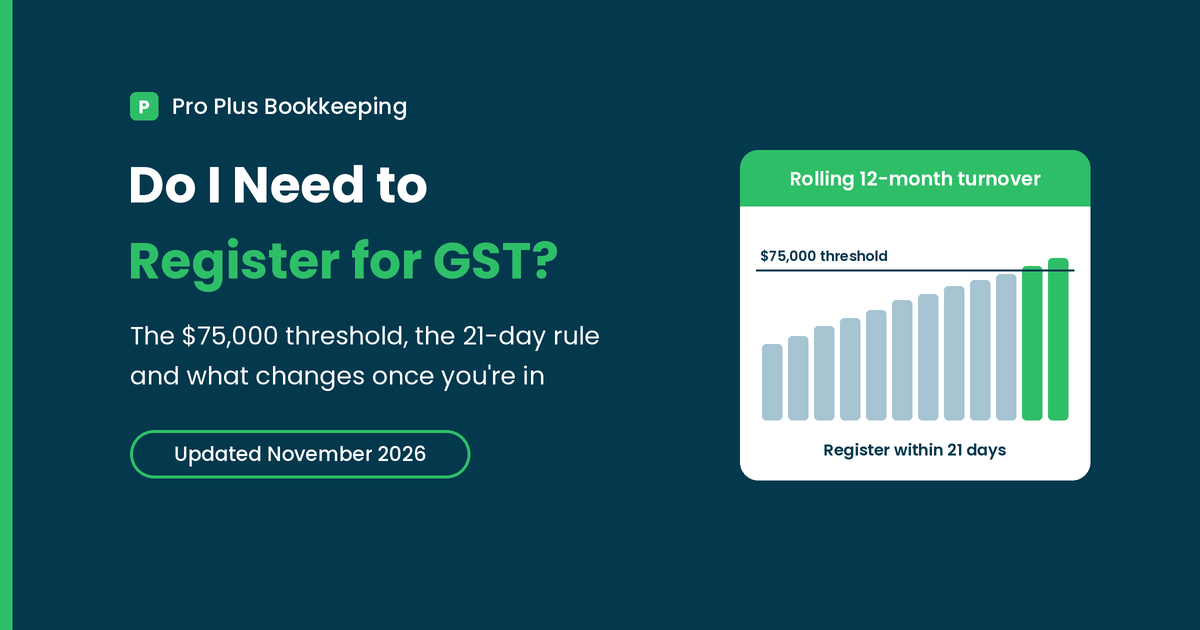
Short answer: you must register for GST once your business’s GST turnover hits $75,000 or more, or is likely to. You’ve got 21 days to register from the point you cross that line. Under $75,000 it’s usually optional, but taxi and rideshare drivers have to register from day one, and you need to be registered to claim fuel tax credits.
The tricky bit is that the test isn’t your tax return figure. It’s a rolling 12-month check you should be doing every month. Here’s how it works, and what changes once you’re in.
When do I have to register for GST?
The ATO says you must register for GST when:
- your GST turnover is $75,000 or more (the GST threshold)
- you’re starting a new business and expect to reach $75,000 in your first year
- you’re a non-profit with GST turnover of $150,000 or more
- you provide taxi, limousine or rideshare travel, whatever your turnover
- you want to claim fuel tax credits.
If none of those apply, registering is your choice. Just know that if you register voluntarily, you generally have to stay registered for at least 12 months.
You need an ABN before you can register. And you only register once, even if you run more than one business.
What counts as GST turnover?
GST turnover is your total business income, not your profit. A tradie who invoices $90,000 and spends $40,000 on materials has a turnover of $90,000, not $50,000.
From that income you take out a few things, including GST you’ve charged, input-taxed sales, sales not connected with your business, and sales not connected with Australia.
If you run several businesses as the same entity (say, a sole trader with two side hustles), the income gets added together. That catches a lot of people out.
The two tests: current and projected
You reach the threshold if either of these is $75,000 or more:
| Test | What you add up | When it bites |
|---|---|---|
| Current GST turnover | This month plus the previous 11 months | Your business has grown past $75,000 over the last year |
| Projected GST turnover | This month plus the next 11 months | You’ve won a big contract or expect strong growth |
A couple of useful exceptions. When you work out projected turnover, you leave out money from selling a capital asset (like a ute or a piece of equipment), and sales you make only because you’re closing or shrinking the business. And even if your current turnover is over $75,000, the ATO says you don’t have to register if it’s satisfied your projected turnover will be under the threshold.
How do I know when I’ve crossed the line?
The ATO’s advice is to check every month. If you’re not registered, add up the last 12 months of sales each month and look ahead at what’s coming in. Once you cross $75,000, the 21-day clock starts.
This is where tidy books pay off. If your sales are in Xero, MYOB or QuickBooks Online, a 12-month profit and loss report gives you the current figure in a few clicks. If you’re working from bank statements and a shoebox, it’s much harder to spot the moment you tip over. Our post on small business record keeping covers the basics.
What if I should have registered and didn’t?
This is the expensive one. If you were required to register and didn’t, you may have to pay GST on sales made since the date you should have registered, even if you never charged GST on them. Penalties and interest may apply too.
In practice, that GST usually comes out of your own pocket. On $100,000 of GST-inclusive sales, one-eleventh is about $9,091. You can ask the ATO to backdate your registration (up to 4 years) by calling its Business enquiries line. If you think you’ve already crossed the threshold, sort it out now rather than waiting for the ATO to find it.
What changes once I’m registered?
Registration isn’t just a box to tick. A few things change straight away:
- You charge GST. GST is 10% on most sales, so think about your pricing before you register. If you don’t lift your prices, the GST comes out of your margin.
- You claim GST credits. You can claim back the GST in your business purchases. For purchases over $82.50 (including GST), you need a tax invoice to make the claim.
- Your invoices change. If a customer asks for a tax invoice, you must give them one within 28 days (unless the sale is $82.50 or less). The ATO lists what a tax invoice needs to show, including your ABN, the date and the GST amount. Sales of $1,000 or more also need the buyer’s identity or ABN. Our post on common invoicing mistakes is worth a look.
- You lodge a BAS. Most small businesses report quarterly.
Monthly, quarterly or annual BAS?
Your GST reporting cycle depends on your GST turnover:
- Quarterly if your GST turnover is under $20 million and the ATO hasn’t told you to report monthly. That’s most small businesses.
- Monthly if it’s $20 million or more. Smaller businesses can choose monthly too.
- Annually if you’re registered voluntarily and your GST turnover is under $75,000.
Our BAS due dates for 2026–27 post has the exact dates.
Cash or accruals?
Businesses with aggregated turnover under $10 million can choose the cash method. That means you pay GST on a sale when the customer actually pays you, not when you send the invoice. For a lot of small businesses that’s easier on cash flow, because you’re not paying the ATO on money you haven’t collected yet.
Should I register for GST voluntarily?
Sometimes it makes sense under $75,000. It can suit you if:
- most of your customers are GST-registered businesses, who can claim back the GST you charge
- you’re about to buy a lot of equipment and want to claim the GST credits
- you expect to pass $75,000 soon anyway.
It’s usually less attractive if you sell mainly to the public, because a 10% price rise is harder to pass on. Remember you’re generally locked in for at least 12 months. If you’re a sole trader weighing it up, our guide to operating as a sole trader has more on getting set up.
GST registration: common questions
How long do I have to register for GST?
21 days from when your GST turnover reaches the $75,000 threshold, or from when you expect it to.
Is the $75,000 GST threshold based on profit or income?
Income. GST turnover is your total business income, less a few items such as GST you’ve charged and input-taxed sales. Expenses aren’t deducted.
Can I backdate my GST registration?
Yes. You can ask the ATO to backdate it by phoning its Business enquiries line. Backdating is generally limited to 4 years.
Do I need to register for GST to claim fuel tax credits?
Yes. You must be registered for GST to claim fuel tax credits, whatever your turnover.
Need a hand with GST?
We’re a Registered BAS Agent in Park Ridge, working with small businesses across Brisbane and Logan. We can check whether you’ve hit the threshold, register you for GST, set up your Xero, MYOB or QuickBooks Online file to track it properly, and look after your BAS lodgement from there. Call 07 3622 6424 (Mon to Fri, 8am to 5pm) or book a free consultation.
General information only, not tax advice. Your situation may differ, so check with the ATO or get advice before you act.

Leave A Comment