
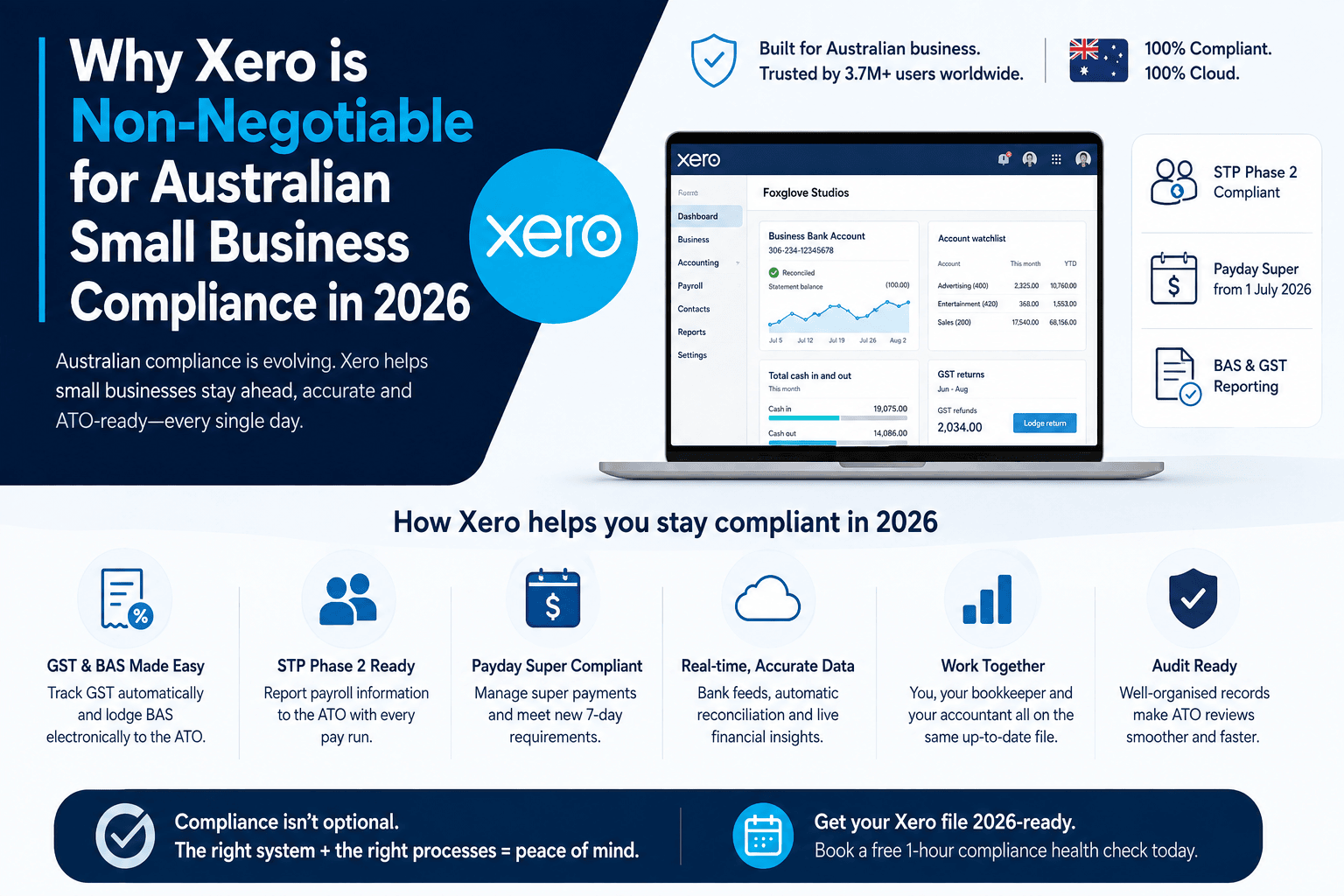
The 2026 Regulatory Shift: Why Cloud Bookkeeping is Now Mandatory
For Australian small business owners, July 1, 2026 is not a deadline to pencil in — it is a compliance cliff that demands immediate action.
The ATO’s Small Business Superannuation Clearing House (SBSCH) closes permanently on that date, eliminating the government-run portal that thousands of small businesses have relied on to process superannuation payments manually. When the SBSCH shuts down, any business without an integrated, SuperStream-compliant solution will face delayed contributions, potential penalties, and significant administrative burden. Manual processes are no longer a workaround — they are a liability.
Integrated software like Xero functions as a SuperStream-compliant hub, routing super contributions directly to employee funds through approved clearing houses, automatically generating the required data files, and maintaining the audit trail the ATO expects. What previously required a separate government portal now lives inside a single dashboard. And because the software reconciles payroll, super, and bank feeds simultaneously, the risk of human error — the kind that triggers ATO scrutiny — drops considerably.
This shift marks a broader turning point. Digital tools that were once optional productivity upgrades are becoming mandatory digital infrastructure for compliant operation. Xero’s small business accounting software sits at the center of that infrastructure, particularly given the ATO’s accelerating push toward Single Touch Payroll Phase 2 and real-time data reporting. The question for most SMEs is no longer whether to move to cloud bookkeeping, but which platform to move to — and that choice matters more than many business owners realize.
Xero vs. QuickBooks: Choosing the Right Australian Market Leader in 2026
With a 70–80% share of Australia’s cloud accounting market for SMEs, Xero is not simply a popular choice — it is the de facto standard around which the entire Australian small business financial ecosystem has been built.
Market dominance translates directly into practical advantages for you as a business owner. When a platform holds that level of market penetration, the surrounding support network — certified advisors, bookkeepers, integration partners, and industry forums — grows proportionally. Finding qualified help, troubleshooting issues, or onboarding a new staff member becomes meaningfully easier when the majority of Australian professionals already know the tool.
Bank feed integration is one area where the gap between Xero and its primary competitor becomes particularly apparent. Xero maintains direct, established connections with Australia’s major banks, including the Big Four, delivering automated, near-real-time transaction data into your ledger. Competing alternatives have historically required more manual intervention or third-party connectors to achieve the same result, adding friction that busy small business owners cannot afford heading into 2026’s tighter compliance environment.
The accountant factor may be the most decisive consideration of all. The overwhelming majority of Australian accountants and bookkeepers are trained, certified, and operationally fluent in Xero. This matters when you are evaluating accountant prices for small business — a shared platform eliminates duplicated data entry, reduces billable hours spent on reconciliation queries, and keeps advisory fees lower over time. Choosing a platform your accountant does not use tends to cost more, not less.
The “free software” myth deserves a direct response. Very small businesses sometimes gravitate toward no-cost tools to minimize overhead, but free accounting software rarely meets the Single Touch Payroll, GST reporting, or ATO data-sharing requirements now central to 2026 compliance. The cost of non-compliance — in penalties and catch-up accounting fees — routinely exceeds a full year of Xero subscription costs.
That foundational ecosystem advantage sets the stage for understanding exactly how Xero’s core features, particularly bank reconciliation and automation, deliver day-to-day operational value.
Mastering Xero Bank Reconciliation and Automation
Xero’s bank reconciliation transforms one of the most time-consuming bookkeeping tasks into a near-automatic daily process — and for Australian small business owners, that shift is operationally significant.
Bank Feeds and Reconciliation. The foundation of Xero’s time-saving power is its live bank feed connection, which pulls transactions directly from Australian financial institutions each business day. Rather than manually entering each line item, you review and match transactions against existing invoices or expenses with a single click. In practice, a business processing 50 to 100 transactions per week can clear its books in minutes rather than hours.
Automated Payment Reminders. Cash flow pressure is a persistent reality for Australian SMEs, and chasing overdue invoices compounds the problem by consuming time you do not have. Xero addresses this directly: Australian small businesses using Xero’s automated payment reminders report spending 50% less time chasing overdue invoices. The system sends scheduled follow-ups without any manual prompting, freeing you to focus on operations rather than accounts receivable.
GST Rules and Recurring Transactions. A particularly practical feature is Xero’s Rules engine, which allows you to apply standardized tax codes to recurring transactions automatically. For businesses navigating Australia’s GST requirements — where the correct classification of taxable, GST-free, and input-taxed supplies matters enormously — this automation reduces both administrative load and the risk of misclassification at BAS time.
Understanding what these features actually cost — and whether managing them yourself delivers genuine savings — is where the next conversation begins.
The Real Cost: Accountant Prices vs. DIY Xero Management
Choosing between software and professional services comes down to one question: what does each option actually cost you, and what do you get in return?
Xero’s 2026 pricing in the Australian market spans three tiers, making it accessible at nearly every business stage. Understanding where your business sits in that range is the starting point for any honest cost comparison:
- Starter: approximately $29–$35/month — suited for sole traders with limited transactions
- Standard: approximately $60–$70/month — covers unlimited invoicing and bank reconciliation
- Premium: approximately $85–$115/month — includes multi-currency and advanced reporting
- Accountant bookkeeping fees: typically $80–$150/hour for ongoing bookkeeping, or $300–$800/month on a fixed retainer for small business clients
- Annual tax return preparation: commonly $500–$2,500 depending on complexity
The DIY challenge is where many business owners quietly lose money. Xero is not technically “free,” but its software cost looks minimal next to professional fees — until you factor in the hours spent reconciling transactions, chasing missing invoices, and correcting BAS errors. A common pattern is that owners underestimate this time by half.
Managed services, however, bundle more than data entry. When you ask how much an accountant charges for a small business and receive a monthly figure, that figure often covers strategic tax planning, ATO compliance oversight, and the kind of proactive advice that software alone cannot provide. Notably, Xero bundles automated superannuation and payroll into all its 2026 pricing plans, which meaningfully reduces the administrative load even when working with an advisor — giving you a credible middle path between full DIY and a costly full-service retainer.
The right choice depends on your transaction volume, compliance risk, and how much your own time is actually worth. That calculation becomes much clearer once your Xero environment is properly configured from day one — which is exactly where setup strategy matters most.
Implementation Strategy: Setting Up Xero for 2026 Success
Switching to Xero business accounting software before the 2026 deadlines is not just about installing an app — it is a structured migration that determines whether your compliance framework holds up under ATO scrutiny.
A common pattern is that businesses underestimate setup complexity and go live with default settings that do not reflect Australian tax obligations. A deliberate, phased approach avoids that trap. The four steps below build on each other, so sequence matters.
- Migrate from legacy or desktop systems. Export your existing data — chart of accounts, customer and supplier lists, opening balances — and import it into Xero using its guided migration tools. A practical setup walkthrough recommends reconciling your closing balances in the old system first, so your opening Xero figures are clean from day one.
- Configure the Chart of Accounts for Australian tax requirements. Xero’s default chart needs adjustment for GST codes, BAS categories, and industry-specific accounts. Getting this right early prevents reclassification headaches at EOFY.
- Integrate Single Touch Payroll Phase 2. STP Phase 2 requires disaggregated income reporting directly to the ATO each pay run. Enabling this inside Xero connects payroll to your ATO lodgment obligations automatically — and 93% of users agree the platform helps them maintain ATO compliance through exactly these automated features.
- Study the 2026 EOFY guide before your first financial year closes. New users consistently overlook year-end reconciliation steps, particularly around depreciation schedules and superannuation clearing accounts.
With the structural groundwork in place, understanding the broader compliance landscape heading into 2026 becomes the natural next priority.
What You Need to Know: 2026 Bookkeeping Essentials
The 2026 compliance window is closing faster than most small business owners realize, and the decisions you make in the next few months will determine whether your payroll, superannuation, and reporting systems are ready when the deadlines land.
The most immediate pressure point is the July 1, 2026 SBSCH closure. The ATO’s Small Business Superannuation Clearing House is shutting down, which means any business still relying on it to process super contributions must transition to a SuperStream-compliant alternative before that date. This is not a soft recommendation — it is a hard cutoff. Businesses that delay will face processing gaps, potential penalties, and the kind of last-minute scramble that tends to cost more than a planned migration ever would.
Against that backdrop, Xero stands out as the dominant choice for Australian businesses, commanding a 70–80% share of the cloud accounting market locally. That market share reflects something practical: the software is purpose-built for the Australian regulatory environment, with STP Phase 2 and SuperStream functionality embedded directly into its payroll module. You are not retrofitting compliance onto a generic tool — it is already there.
Automation is the other factor worth keeping front of mind. Xero’s automated invoicing and payment reminder workflows reduce invoice chasing time by up to 50%, which has a direct and measurable impact on cash flow. For small businesses operating on tight margins, that efficiency gain is not cosmetic — it translates into faster collections and fewer late-payment crises.
The final consideration is setup quality. Even well-designed software produces compliance gaps when it is configured incorrectly. Professional setup ensures that your STP reporting codes, pay item classifications, and superannuation funds are mapped accurately from day one. What typically happens when businesses self-configure under time pressure is that errors compound quietly until a BAS lodgment or ATO audit surfaces them. Avoiding that pattern is worth the upfront investment — and it is precisely the kind of support that separates a smooth 2026 transition from a stressful one.
Future-Proofing Your Australian Business with Proplusbooks
The 2026 compliance transition is not something Australian small business owners can navigate effectively alone — professional guidance is the difference between a smooth migration and a costly, last-minute scramble.
Professional support matters now more than ever. As the previous sections have outlined, the combination of ATO digital reporting mandates, Single Touch Payroll Phase 2, and evolving GST obligations creates a compliance environment where the margin for error is slim. Xero business accounting software provides the foundation, but configuring it correctly for your specific industry, payroll structure, and reporting obligations requires expertise that goes well beyond a basic setup.
The June 2026 rush is a real and documented risk. What typically happens is that businesses delay migration until deadlines are imminent, which compresses timelines, limits access to qualified bookkeepers, and increases the likelihood of data transfer errors. According to Xero’s Australian SME market data, adoption is accelerating — meaning qualified implementation support will only become harder to secure as the year progresses. Acting now protects both your compliance standing and your access to expert help.
Proplusbooks supports Australian SMEs through every stage of this digital transformation — from initial compliance audits and chart-of-accounts configuration to payroll migration and ongoing reconciliation support. The goal is not simply to get you onto Xero, but to ensure the platform works in alignment with your business structure from day one. That distinction tends to be what separates businesses that thrive through the 2026 transition from those that struggle through it.
And the starting point is straightforward. If you are unsure whether your current setup meets 2026 compliance requirements, a dedicated compliance audit or setup consultation with Proplusbooks will identify the gaps and build a clear action plan. Do not wait for the deadline pressure to make that decision for you — book your consultation with Proplusbooks today and move into 2026 with confidence.


Leave A Comment