
Last updated by Parminder
Last updated 25 November 2026. Checked against the ATO’s pages on fuel tax credits for business, fuel tax credit rates and completing the BAS fuel labels.
Short answer: fuel tax credits give you back the fuel tax built into the price of fuel you use in your business. That covers machinery, plant, equipment, heavy vehicles, and light vehicles used off public roads. You claim them on your BAS, but only if you’re registered for GST and for fuel tax credits.
With the 2026 excise cuts, rates have moved around a lot this year. Here’s how it works.
What are fuel tax credits?
When you buy diesel or petrol, the price includes fuel tax (excise or customs duty). The ATO says fuel tax credits give businesses a credit for that tax when the fuel is used in:
- machinery
- plant
- equipment
- heavy vehicles
- light vehicles travelling off public roads or on private roads.
The amount depends on when you bought the fuel, what fuel it is, and what you used it for.
Can I claim fuel tax credits for my ute or car?
Not for driving on public roads. The ATO lists fuel used in light vehicles of 4.5 tonnes gross vehicle mass (GVM) or less on public roads as ineligible. That’s your car, small van or ute on the way to a job.
But if that same ute burns fuel off public roads, such as on a work site, mine site or private road, the fuel used there can be eligible. Fuel for private use, or fuel that’s lost or stolen, doesn’t qualify.
What about trucks over 4.5 tonnes?
Heavy vehicles are where most small businesses claim. A vehicle needs a GVM over 4.5 tonnes and has to be used in your business. The ATO also explains that fuel used travelling on public roads gets a lower rate, because it’s reduced by the road user charge. Travelling includes idling during the trip and running the cab air-con.
Two other points catch people out:
- Auxiliary equipment such as a refrigeration unit, concrete mixer barrel or bin lifter uses the higher “all other business uses” rate.
- Older diesel trucks made before 1 January 1996 have to meet an environmental criterion (for example, the DT80 test or an accredited maintenance program) before you can claim for them on public roads.
What are the fuel tax credit rates right now?
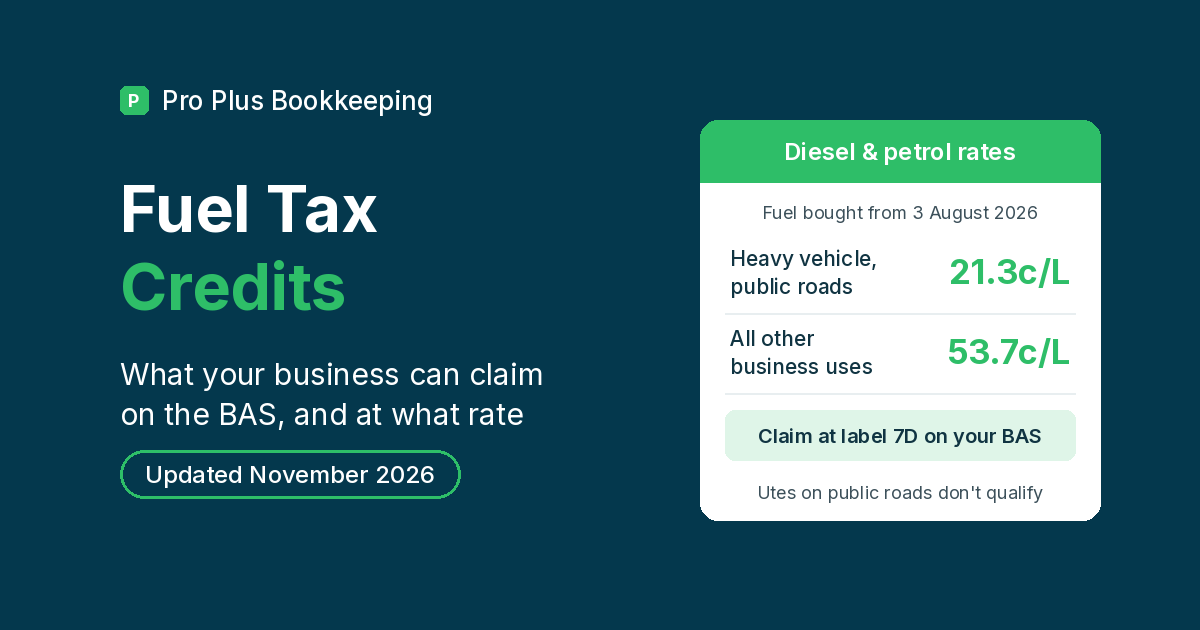
Rates are indexed in February and August, and the road user charge changes too. You use the rate that applied on the date you acquired the fuel. Here’s diesel and petrol for 2026–27 so far.
| Fuel acquired | Heavy vehicle, travelling on public roads | All other business uses |
|---|---|---|
| 1 July to 2 August 2026 | 20.2 cents per litre | 36.6 cents per litre |
| From 3 August 2026 | 21.3 cents per litre | 53.7 cents per litre |
Rates for LPG, LNG, CNG and biofuels are on the same ATO page. Expect new rates in February 2027.
Why were the rates lower earlier in 2026?
Fuel excise was cut for a while. The ATO’s rates page says excise was reduced by 60.9% from 1 April to 30 June 2026, then by 30.4% from 1 July to 2 August 2026. If you’re catching up on claims from those months, don’t use today’s rates. The ATO’s fuel tax credit calculator has the right rate for each period.
How do I register and claim on my BAS?
You need to be registered for GST when you buy the fuel, and for fuel tax credits when you lodge the claim. You can register for fuel tax credits in Online services for business (Profile, then Tax registrations, then Add), or your registered tax or BAS agent can do it for you. Not registered for GST yet? Our guide on whether you need to register for GST is a good place to start.
On the BAS, two labels matter:
- 7D, fuel tax credit: the credits you’re entitled to for the period, plus any adjustments that increase them. Put 0 if there’s nothing. Don’t leave it blank.
- 7C, fuel tax credit overclaim: only for reducing a credit you claimed before, for example if the fuel was later sold or used at a lower rate.
Timing follows your GST accounting. On a cash basis, you claim in the BAS period you pay for the fuel. On a non-cash basis, you claim in the period you get the invoice. Fuel tax credits can only go on a BAS, not an annual GST return. Our BAS due dates for 2026–27 list when each quarter is due.
Can I claim fuel tax credits I missed?
Usually, yes. The ATO says you generally have 4 years to claim a credit you haven’t claimed before. The clock starts the day after the BAS for that period was due. You can add it to your current BAS or revise the earlier one, but either way you use the rate from when you bought the fuel.
What records do I need to keep?
The ATO wants records kept for five years that show how much fuel you bought, what you used it for and how you split eligible and ineligible use. Handy checklist:
- tax invoices, fuel card or supplier statements
- odometer readings, logbooks or GPS data for trucks that run on and off public roads
- job sheets or contracts showing the work the fuel was used for
- a copy of your fuel tax credit calculator results or worksheet.
In Xero, code fuel for eligible vehicles and equipment to its own account. Then 7D isn’t a hunt through receipts at BAS time.
Is there an easier way for small claims?
Yes. If you claim less than $10,000 a year, the ATO’s simplified methods let you:
- use the basic method for diesel in heavy vehicles, based on public road kilometres and litres of eligible diesel
- use the rate on the last day of the BAS period, instead of splitting purchases when the rate changes
- work out litres as total fuel cost divided by the average price per litre
- rely on records like bank statements or dockets that only show a dollar amount.
Fuel tax credits: common questions
Do I need to be registered for GST to claim fuel tax credits?
Yes. You must be registered for GST when you acquire the fuel and registered for fuel tax credits when you lodge your claim.
Where do fuel tax credits go on the BAS?
At label 7D. Use label 7C only to reduce a credit you claimed before. If there’s nothing to report at either label, enter 0.
Can I claim fuel tax credits for a ute?
Not for fuel used on public roads, because light vehicles of 4.5 tonnes GVM or less aren’t eligible there. Fuel the ute uses off public roads or on private roads in your business can be eligible.
How far back can I claim fuel tax credits?
Generally 4 years. The time limit starts the day after the BAS for the period was due, and you use the rate that applied when you bought the fuel.
Want your fuel tax credits checked?
We’re a Registered BAS Agent in Park Ridge, working with businesses across Brisbane and Logan. We can set up fuel tracking in Xero, MYOB or QuickBooks Online, work out your claim and lodge it with your BAS. Call 07 3622 6424 (Mon to Fri, 8am to 5pm) or book a free consultation.
General information only, not tax advice. Rates and rules change, so check the ATO or get advice before you claim.

Leave A Comment